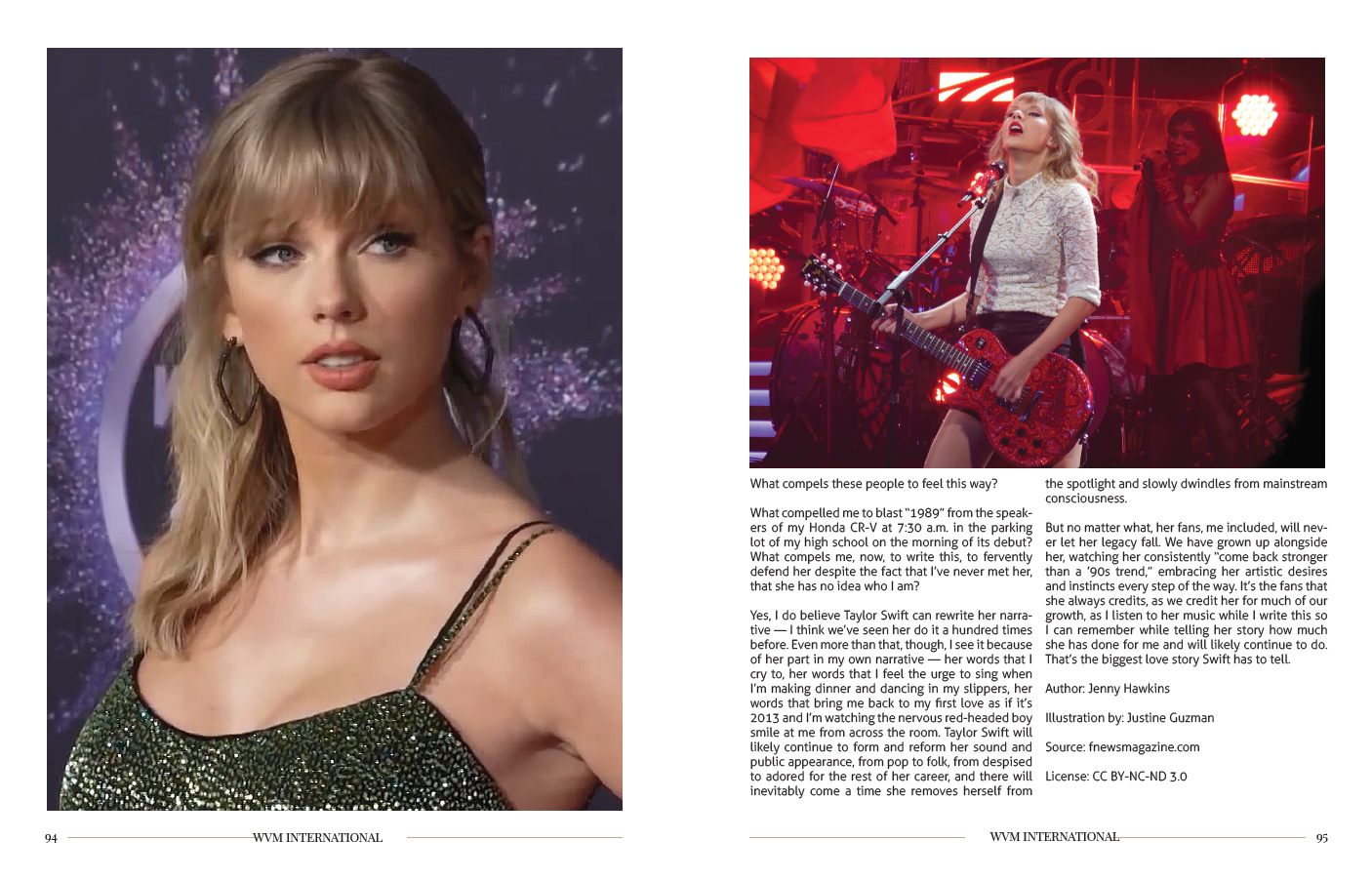
Taking a look back at Taylor Swift’s narrative.
I recently had someone tell me that she loves Taylor Swift now, but “hated her when it was cool to hate her.” Even now, after 14 years of being a fan, this bothers me. Swift is much more than good music and entertainment — she is a voice, a bit of warmth, someone who understands our feelings which we cannot put into words. Many of us who grew up with her experienced middle school, high school, and college with her discography as a soundtrack for our own lives, and her specific yet accessible lyrics make it astonishingly easy to do this.
Simply trying to write a somewhat objective piece about Swift is a struggle for me because she has created such a rich bond with her fanbase that it is so easy to feel loyal and even indebted to her. As a fellow songwriter, she has always been an inspiration to me, with that humble country background beginning in a little café in Nashville making her success seem almost within reach. Not just for aspiring artists, though; she has always had a way of breaching the gap between herself and her followers, from crowdsurfing and squeezing fans’ hands in her first tour, to sharing inside jokes on social media and contributing to fans’ GoFundMe fundraisers. However, her innocent disposition and vulnerable writing style have been used as weapons against her by casual listeners and fellow artists alike.
From Kanye interrupting her 2009 VMA award acceptance speech to Katy Perry allegedly stealing her tour dancers in 2012 to Scooter Braun buying her former record label in 2019 — Swift’s rampant success has ensnared her into some of the biggest front-page stories in popular media over the last fifteen years, leading her to ruthless public scrutiny.
The worst of the condemnation began after her fourth studio album, “Red,” hit shelves in 2012 and it seemed that Swift went from being America’s sweetheart to being perceived as a serial dater with an obnoxious victim complex. She was shamed by fans and fellow stars alike for referencing celebrities she had publicly dated in her songs, sometimes by name. While she had to have known it would make her a target, it also created a devoted fanbase who appreciated the way she kept her heart on her sleeve throughout years of growing fame. She was never hesitant to call someone else out, not even herself.
Take “Back to December,” the second single from “Speak Now” (2010) — this was released shortly after Swift’s public yet brief relationship with “Twilight’s” Taylor Lautner (as a couple they were “Taylor squared”) and in it she confesses her regret in taking him for granted (“it turns out freedom ain’t nothing but missing you / wishing I’d realized what I had when you were mine”), admitting her own missteps and apologizing to the subject of the song. On that same album, she wrote “Dear John,” widely known to be about singer John Mayer, who she mercilessly accuses of breaking her heart (“Don’t you think nineteen’s too young to be played by / your dark twisted games / when I loved you so? I should’ve known”).
When “Red” was released, Swift was 23, and although she still existed in the country genre, presenting herself as a cherry-lipped, soft-spoken young woman, she began to be criticized for writing too much about her relationships and being “immature.” Once the criticism began spreading, there was no stopping it (think COVID in Florida during spring break). Hating her became a trend — lifelong fans such as myself can attest to the struggle of being a supporter during these dark years. One fan warned others on Twitter to watch what they say online in the name of defending Swift, because “[reporters] are going to be shaping the narrative around our behavior.” The loyalty among fans is so fierce, many fans will go to extreme lengths to protect Swift’s name. My best friend in the 9th grade was a Directioner (One Direction’s fandom) and let me tell you, that was the equivalent of Trump vs. Biden supporters in 2020 for high schoolers in 2013. I’m not proud of the amount of times she had me in tears by trash-talking Taylor Swift.
The biggest and most innovative forms of connection with her fans began in 2014 with her album “1989.” She started doing what she called “secret sessions,” where she would invite a group of fans to her homes in different cities across the U.S. and in the U.K. to spend time with her and listen to her albums before they were released.
Author: Jenny Hawkins
Source: fnewsmagazine.com
License: CC BY-NC-ND 3.0s eget a, in ultrices tellus posuere, justo euismod rutrum pariatur hac, faucibus tempus ullamcorper. A ligula dolor euismod, ornare massa leo, in per massa lorem lobortis, donec dolor sed.
You can read the entire article in the 1st issue of WVM International: